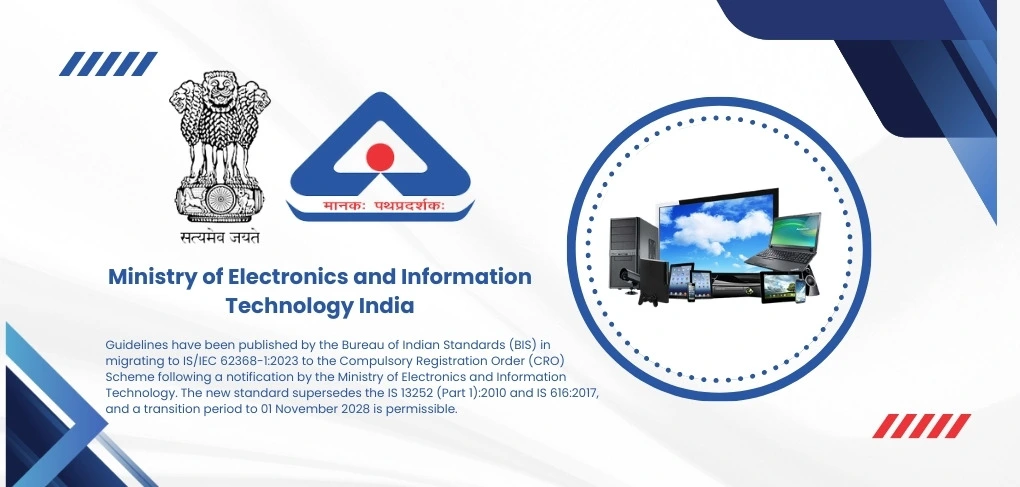
The Bureau of Indian Standards (BIS) has released new guidelines for the implementation of migration to IS/IEC 62368-1:2023 following the notification issued by the Ministry of Electronics and Information Technology (MeitY). This update is part of the Electronics and Information Technology Goods (Requirement of Compulsory Registration) Order, 2021, which regulates safety standards for electronic and IT products sold in India.
The transition to IS/IEC 62368-1:2023 represents a significant modernization of safety standards for audio/video, information technology, and communication technology equipment. Manufacturers, importers, and brand owners must understand the migration timeline and compliance requirements to ensure uninterrupted market access.
Background of the Notification
On 29 October 2025, MeitY issued notification S.O. 4997(E) introducing the new standard IS/IEC 62368-1:2023 – Audio/Video, Information and Communication Technology Equipment – Safety Requirements.
This new standard supersedes the following existing Indian Standards:
- IS 13252 (Part 1):2010 – Information Technology Equipment Safety
- IS 616:2017 – Audio, Video and Similar Electronic Apparatus Safety
The migration aims to harmonize Indian safety requirements with international standards and improve safety measures for modern electronic devices.
Concurrent Running Period
To facilitate a smooth transition, BIS has allowed a concurrent running period until 01 November 2028. During this period, manufacturers may continue using the existing standards while preparing to migrate to the new standard.
SAfter this date, IS/IEC 62368-1:2023 will become the mandatory standard for applicable products under the CRO scheme.
Products Covered Under the Migration
The migration applies to several electronic and IT products currently registered under BIS. These include:
- Electronic Video Games
- Laptops, Notebooks, and Tablets
- Plasma, LCD, and LED Televisions
- Optical Disc Players with built-in amplifiers (200W and above)
- Visual Display Units and Video Monitors
- Printers, Multi-Function Devices (MFDs), and Plotters
- Scanners and Barcode Readers
- USB-driven biometric devices (iris scanners, fingerprint scanners)
- Wireless Keyboards
- Telephone Answering Machines
- High-power Amplifiers
- Electronic Musical Systems
Manufacturers producing these products must plan their transition to the new standard before the final deadline.
Importance of IS/IEC 62368-1:2023
The newly introduced standard focuses on a hazard-based safety engineering (HBSE) approach, replacing the traditional prescriptive safety methods used in earlier standards. Key advantages include:
- Improved protection against electrical, mechanical, and thermal hazards
- Alignment with global safety practices
- Simplified compliance for modern multimedia devices
- Better adaptability to evolving technology
This standard is widely used internationally for ICT and AV equipment safety, ensuring safer products for consumers.
What Manufacturers Should Do
To comply with the new guidelines, manufacturers should take the following steps:
- Review their existing BIS registrations under the CRO scheme
- Initiate product testing as per IS/IEC 62368-1:2023
- Update technical documentation and safety assessments
- Apply for migration or new BIS registration before the deadline
- Coordinate with BIS-recognized laboratories for testing
Early preparation will help businesses avoid certification delays and ensure uninterrupted product sales in India.
Impact on the Electronics Industry
The transition to IS/IEC 62368-1:2023 marks a major step toward strengthening safety compliance in India’s electronics sector. With increasing convergence of audio, video, and IT technologies, adopting a unified safety standard will enhance consumer protection while aligning India with global regulatory frameworks.
Conclusion
The guidelines issued by BIS provide a clear roadmap for migrating to IS/IEC 62368-1:2023 under the CRO scheme. With the concurrent running period ending on 01 November 2028, manufacturers should start the transition process early to avoid disruptions in certification and product approvals.
Proactive compliance will ensure smooth market access while meeting the evolving safety requirements of India’s electronics industry.