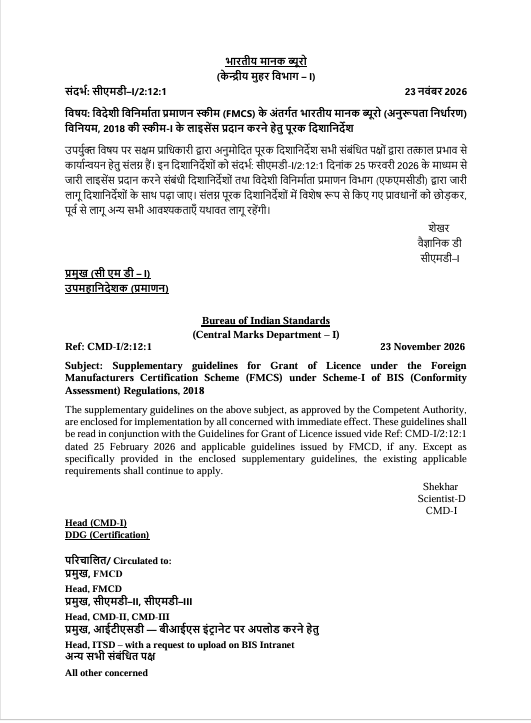
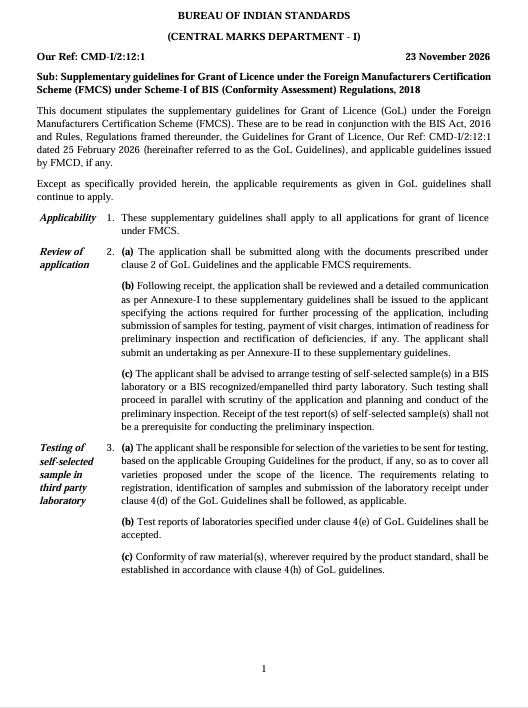
On 23 November 2026, the Bureau of Indian Standards (BIS) introduced new supplementary guidelines for licensing under the Foreign Manufacturers Certification Scheme (FMCS). Issued by the Central Marks Department-I, these guidelines aim to simplify the BIS FMCS certification process and improve product testing procedures. They establish clear requirements for foreign manufacturers seeking to use the BIS Standard Mark in India.
The new guidelines apply to all applications for licensing under the FMCS and are effective immediately. They should be read in conjunction with the existing BIS Guidelines for Licensing as of 25 February 2026, and other applicable FMCS requirements.
These changes are particularly important for foreign manufacturers exporting products to India that meet the required BIS certification requirements.
What are the New BIS FMCS Guidelines 2026?
The additional guidelines issued by BIS describe the procedures for application scrutiny, product testing, preliminary factory inspection, licence approval and post licence testing.
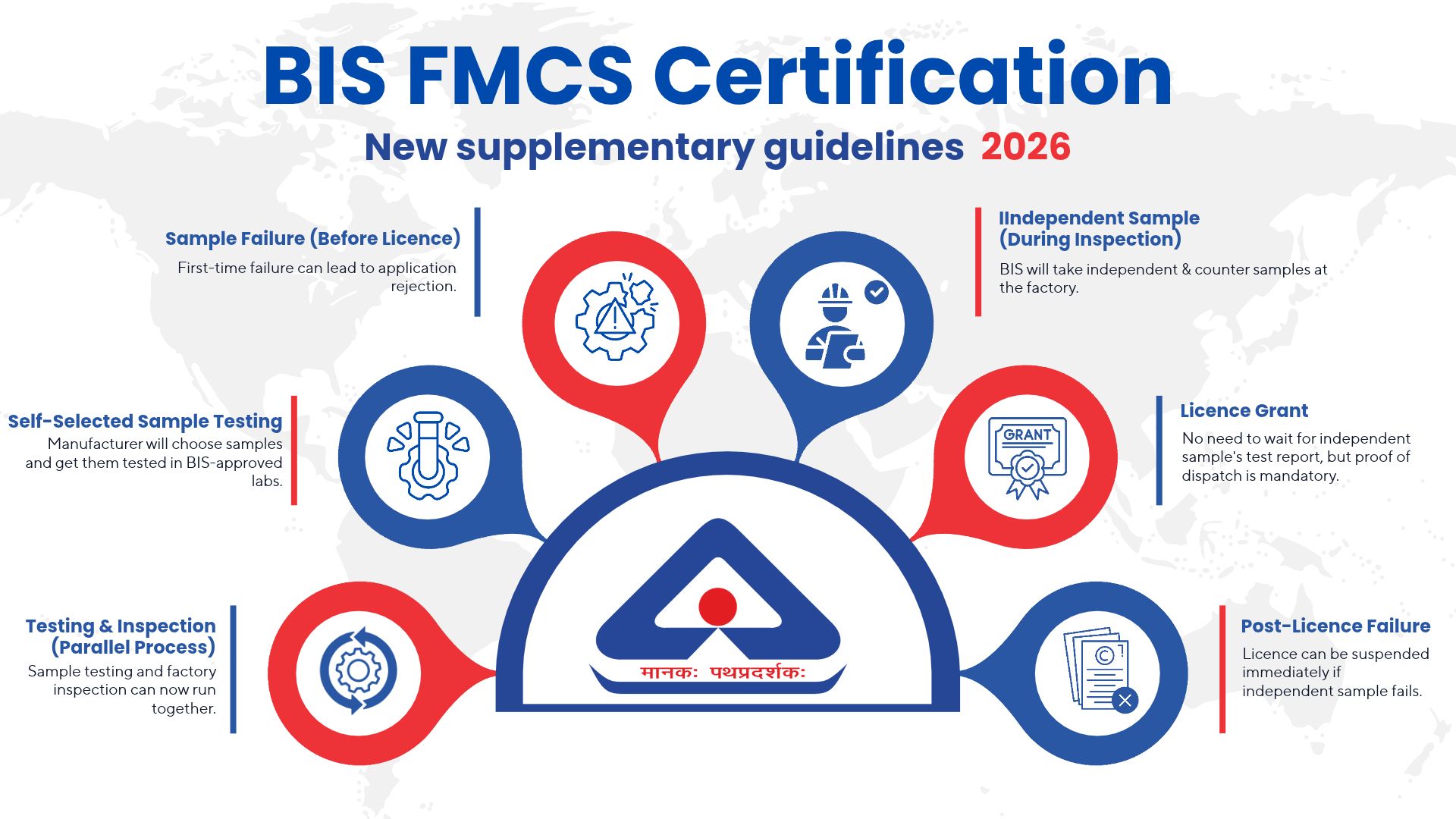
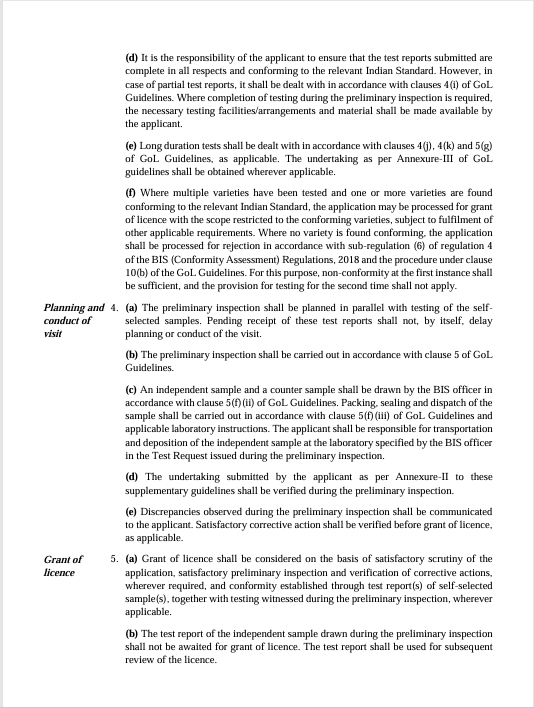
One of the major changes is that BIS can now conduct simultaneous product sample testing and preliminary factory inspection. Earlier BIS had to wait for all the product sample testing reports before conducting the inspection. This would allow BIS to take up additional applications, process them in parallel and therefore increase the overall efficiency of the system.
The guidelines also define responsibilities of applicants regarding selection of samples for testing, payment of testing fees, implementation of corrective actions and testing of samples by third parties.
Important Changes to BIS FMCS Certification Guidelines 2026
The following were the principal changes incorporated in the new supplementary guidelines:
1. Application Review and Document Verification
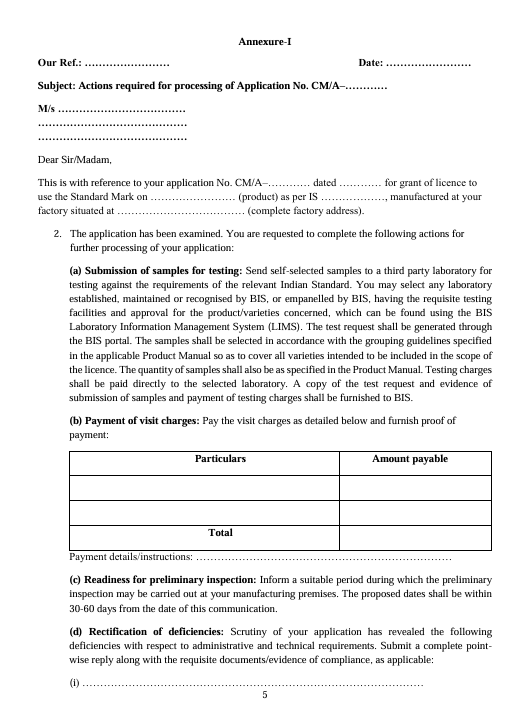
Once BIS receives an FMCS application, it will review the application and check the validity of the certifications referred to in the application. Based on this review, BIS will send a communication to the applicant indicating the next steps in the process. These may include:
i) Submission of samples of the product for test as per their choice.
ii) Payment of fees for preliminary inspection.
iii) Confirmation of readiness for factory inspection.
iv) Resolution of administrative and technical deficiencies.
v) Submission of an undertaking as may be specified by BIS.
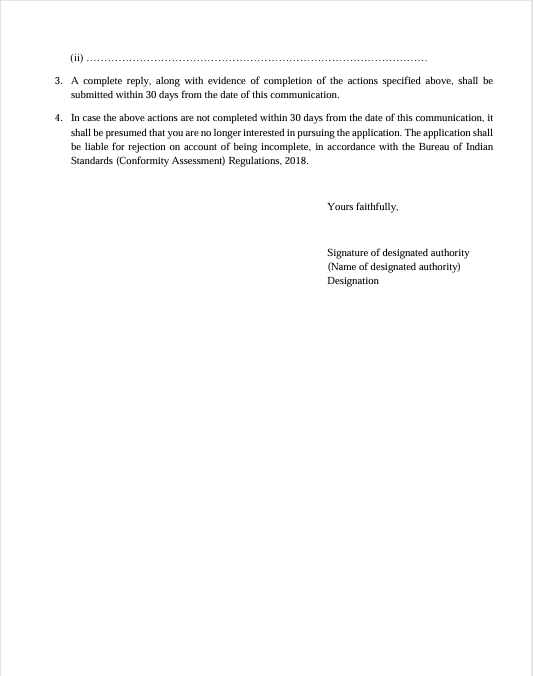
Applicants will be required to complete these steps within a specified time frame.
2. Self-Selected Sample Testing Through Third-Party Laboratories
The responsibility of selecting product samples and arranging for testing of such samples has now been passed on to the foreign manufacturer.
As per the new guidelines, samples must be submitted to a BIS laboratory or a BIS recognized/empanelled third party laboratory in India for testing.
Important points are:
i) Samples must be representative of the product groups as per applicable guidelines.
ii) Samples must be representative of all varieties covered under the scope of the manufacturing licence.
iii) The quantity of samples must be in conformity with the relevant Product Manual.
iv) A test request must be made through the BIS portal.
v) Payment for the test must be made to the selected laboratory.
vi) Evidence of sample submission and payment must be given to BIS.
The applicant is responsible for ensuring that the test reports are complete and conform to the Indian Standards relevant to the product.
3. Product Testing and Factory Inspection Can Proceed Simultaneously
One of the major changes in the BIS FMCS 2026 guidelines is that product tests can be performed in parallel with preliminary inspection of the factory.
Earlier, manufacturers had to wait for the factory inspection date before product tests could be conducted.
As per the additional guidelines:
i) Simultaneous sampling and test consideration can take place.
ii) BIS can conduct a preliminary factory inspection while testing is in progress.
iii) The test reports of the self selected samples need not be submitted to BIS prior to the preliminary factory inspection.
This is expected to reduce the waiting time for the manufacturers during the certification process.
4. Independent Sample Collection During Factory Inspection
During preliminary inspection, the BIS officer will take two samples.
i) Independent sample
ii) Counter sample
The samples will be packaged and sealed as per BIS guidelines and lab instructions.
It is the responsibility of the applicant to arrange transport of the independent sample to the laboratory designated by the BIS officer.
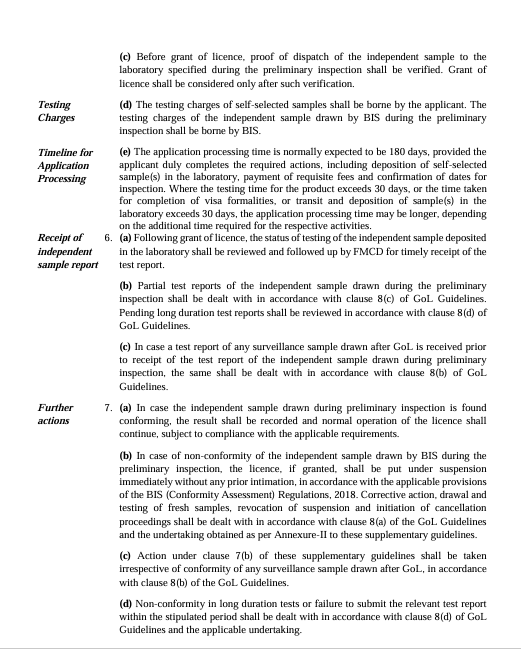
The applicant has to produce proof of dispatch of the independent sample to the laboratory prior to BIS considering the application for grant of licence.
5. Licence Grant Without Waiting for Independent Sample Test Report
Another important provision is that BIS may grant the licence without waiting for the test report of the independent sample collected during the preliminary inspection.
There are, however, five conditions that must be satisfied:
i) The application must be satisfactorily scrutinized.
ii) The preliminary factory inspection must be satisfactory.
iii) Corrective actions have been taken and are satisfactorily verified.
iv) The self-selected sample test reports have established that the product is in conformity.
v) The products are tested during the preliminary inspection.
vi) Proof of dispatch of the independent sample has been verified.
The independent sample test report will be used to review the licence.
6. New Rules for Non-Conforming Product Samples
The additional criteria outline certain conditions relating to product sample failures.
Case 1: Self-selected Sample fails
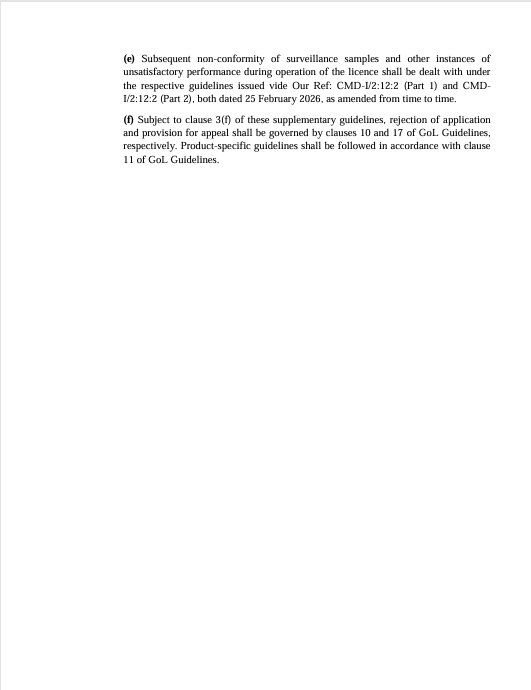
If any product sample, self-selected by the applicant, is found to be non-conforming to the applicable Indian Standard, the application may be rejected on the first instance. A second test of the sample would not be permitted.
If in a single application, multiple varieties of the product are tested and some of those varieties conform to the Indian Standard, then BIS may grant the licence with restricted scope to those varieties that conform to the Indian Standard, subject to satisfaction of other conditions.
Case 2: Independent Sample fails post licence grant
The licence will be suspended without prior notice to the manufacturer, if the independent sample collected by BIS during preliminary inspection is found to be non-conforming. The manufacturer, on suspension of the licence, must take necessary action to correct the non-conformity and to inform BIS about the same and also confirm within 30 days of the suspension that he is in a position to offer the product sample which conforms to the Indian Standard. The manufacturer has to get the sample tested by a third party laboratory and on submission of a satisfactory report by such laboratory, the suspension will be removed. If the sample still remains non-conforming or in case the manufacturer does not offer improved samples within 30 days of the suspension, then BIS will take up the process of cancelling the licence.
BIS FMCS Certification Processing Timeline 2026
As per the additional instructions, the expected application processing time would be 180 days from the date of completion of the activities listed by the applicant. The activities are:
i) Submission of sample of the product.
ii) Payment of applicable fees
iii) Conduct product test
iv) Confirm inspection dates.
v) Submit documents containing corrective actions.
It may, however, be extended to:
i) More than 30 days in case product testing takes more than 30 days
ii) In case of visa processing time taking more than 30 days.
iii) Sample transportation and deposit to the laboratory takes more than 30 days.
The expected processing time of 180 days may also be extended based on the reason for the delay and the duration for which the extension is required.
Important Responsibilities of Foreign Manufacturers
Foreign manufacturers applying for BIS FMCS certification must carefully understand their responsibilities under the new provisions.
| Activity | Manufacturer's Responsibility |
| Application | Submit complete application and prescribed documents |
| Sample Selection | Select varieties according to grouping guidelines |
| Product Testing | Arrange testing through an eligible BIS laboratory or recognised third-party laboratory |
| Testing Charges | Pay testing charges for self-selected samples |
| Factory Inspection | Confirm readiness and facilitate preliminary inspection |
| Independent Sample | Arrange transportation and laboratory deposition |
| Corrective Action | Rectify identified deficiencies and non-conformities |
| Undertaking | Submit the prescribed undertaking to BIS |
What Documentation and Preparations are necessary for BIS FMCS Certification?
Foreign manufacturers should be ready with adequate technical documentation to provide with their FMCS application to avoid unnecessary delays.
These include:
i) Address of the manufacturing facility.
ii) Details of the product and the Indian Standard to which it is compared.
iii) Detailed process of manufacture of the product.
iv) Methods of quality control and tests.
v) Types of the product covered under the FMCS licence.
vi) Product testing report where relevant.
vii) Undertakings, if any, necessary to be given.
viii) Readiness of the factory for inspection and presence of adequate test facilities.
The exact nature of the documentation required will depend on the product, Indian Standard relevant to the product and the product manual.
PDF Link
BIS FMCS Certification New Guidelines 2026
How Aleph India Can Help with BIS FMCS Certification
Obtaining BIS FMCS certification is more complicated for manufacturers outside of India. This is because of the many different requirements including, understanding of Indian Standards, product testing, preparing factory for BIS inspection, and completing other admin requirements.
Aleph India assists foreign manufacturers and exporters with BIS FMCS certification to access the Indian market. We help them to understand Indian Standards applicable to their product as well as BIS certification requirements. Based on our understanding of the client’s product, we assist with completing various documentation and applications to BIS and provide them guidance through the FMCS application process.
We provide the following services:
- Identification of Indian Standards applicable to client’s product and requirements for BIS certification
- Guidance on the FMCS application process.
- Assistance in completion of documentation for the application.
- Guidance on product testing to be conducted by eligible laboratories.
- Guidance on selection and grouping of samples.
- Preparation for factory inspection.
- Interpretation of BIS observations and non-conformities.
- Support during licence grant process and post licence compliance.
With adequate consultancy support, manufacturers can become better informed about recent modifications in FMCS and efficiently manage the certification process.
Conclusion
The new guidelines for BIS FMCS certification 2026, released on 23rd November 2026, bring about several changes in the process for obtaining a foreign manufacturer’s license. These changes include, among others, the introduction of parallel processing of product testing and preliminary inspection, modification in the procedure for independent sample testing, a stipulated processing time of 180 days, and more stringent requirements for dealing with non-conforming samples. Foreign manufacturers are advised to go through these additional guidelines in detail and ensure that their products, associated documents, sample testing and manufacturing facilities meet the requirements of BIS before applying for a license. For assistance in obtaining BIS FMCS certification, foreign manufacturers may approach Aleph India, a BIS certification service provider.