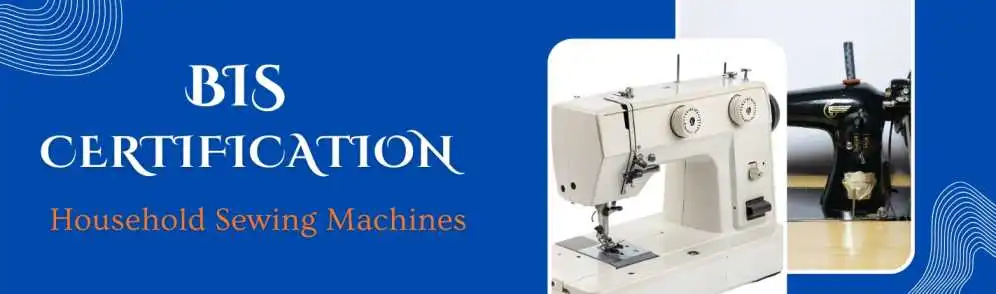
BIS certified household sewing machines with assured quality, safety and performance As per IS 1610, household sewing machines are also required to have BIS Certification. These are extensively used for stitching, mending and tailoring the fabrics in homes as well as small establishments. Certified machines have a guaranteed exchange, accept returns for repairs, or hand them back when there is supported after-service.
BIS Certified household sewing machines with assured quality and after sales services. Certification verifies that the machines meet predetermined levels of safety and function requirements, such as electrical safety, mechanical strength and operation stability. Certified Products The ease of use, decrease in incidence of accidents and reliability in stitching that certified products are known for are a necessity for normal household use.
Sewing machines run for long durations in the households and small tailoring units. An incorrectly designed or uncertified welding machine could be dangerous, and that includes electrical shock, overheating, or breaking down. The risk of hazards can be significantly reduced if the household sewing machines used are BIS - certified and they meet specific safety standards. They guarantee a safe motor operation, properly insulated body, steady moving parts and controlled noise & vibration levels - all of which support the health and comfort of your users.
Aside from home use, domestic sewing machines are also used in greater capacities for clothing or upholstery production with shop settings such as tailors' shops and to its equivalent. In this kind of environments, safety and reliability are fundamental. With BIS certification, the machine guarantees of reliable performance and scores high on quality standards. In India, it is illegal to manufacture or sell non-certified household sewing machines, and can lead to legal as well regulatory action.
IS 1610 - Household Sewing Machines
IS 1610 is an Indian Standard issued by the Bureau of Indian Standards (BIS) for domestic sewing machines. This Indian Standard lays down requirements regarding construction, performance, safety and testing of domestic sewing machines. It includes issues in relation to electrical safety, mechanical strength, safeguarding of moving parts, robustness and workmanship. Various machines as per IS 1610 are being used but they tend to operate in unsafe condition and the quality of briquette produced is not consistent.
IS 1610 also specifies the testing arrangements to determine the performance, safety and reliability of household sewing machines under given conditions. Two Master Packs Compression Force Compliance to this standard is a pre-condition for BIS Certification/urgent requirements of statutory authorities in India. Compliance to IS 1610, Is a must for all manufacturers, so as to guarantee product safety and quality.
Why BIS Certification is Required for House Hold Sewing Machines?
The Bureau of Indian Standards (BIS) came into existence on 1 April the year 1987 under BIS Act, 1986 to promote standardization and marking of products in India. Domestic sewing machines are required to comply with BIS as they have both electrical and mechanical parts which affect the safety of the user. Now as a statutory body BIS will ensure only the machines meeting Indian Standards are sold to consumers.
The requirements in IS 1610 are reviewed on a regular basis to keep abreast of advances in technology and changes in safety philosophy. Not adhering to BIS certification does more than just not meet the legal requirements, since it leads to loss of consumer trust and product credibility in the manufacturing company your use is also put under risk. BIS-certified This household sewing machine is contributing to a safer home, better performance and confidence of the user across India.