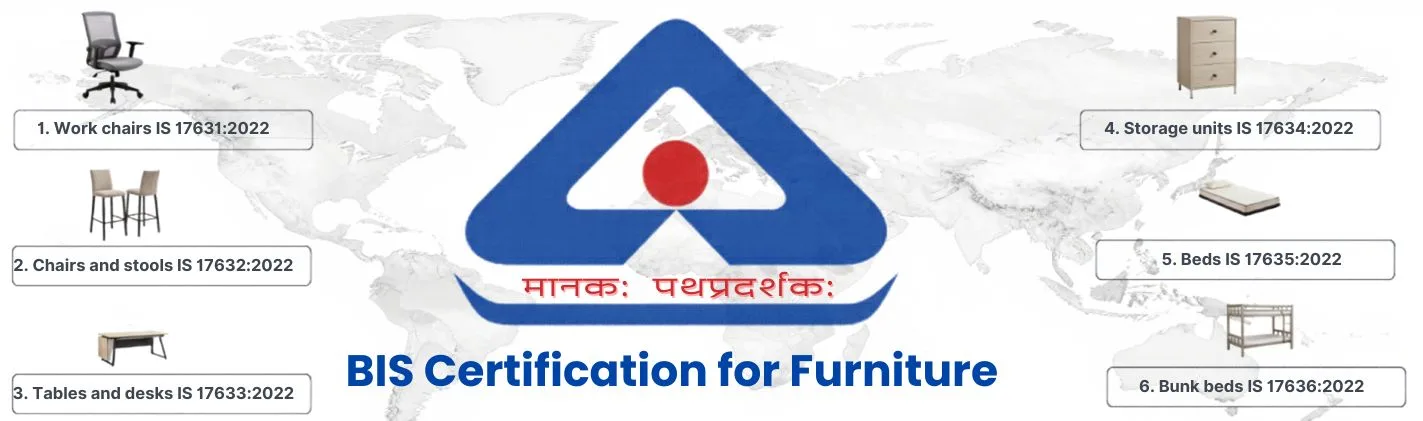
There are six furniture product groups which are notified for BIS certification in India work chairs, general-purpose chairs and stools, tables and desks, storage units, beds and bunk beds. As per Furniture (Quality Control) order 2025, the products cannot be manufactured, imported or offered for sale without BIS licence and ISI mark.
This is no longer a problem if you make or import furniture. The additional time granted to small units is also over and the order took effect in February 2026. This guide clarifies what is included, who needs to follow it, how it works and where businesses often go wrong.
Who Needs BIS Furniture Certification in India?
The Manufacturers, Importers, Brand Owners and other businesses involved with furniture products under the relevant Furniture Quality Control Order (QCO) 2026 are required to be BIS certified. It is applicable for notified furniture products which are produced, imported, distributed or sold in the Indian market. The different businesses will have to ensure compliance with the relevant Indian Standards and BIS certification depending on their role in the supply chain.
- Indian Manufacturers: Indian manufacturers producing furniture products covered under the applicable Indian Standards must obtain a valid BIS license. Certified products are permitted to bear the ISI Mark and can be legally manufactured and marketed in India.
- Foreign Manufacturers: Under Foreign Manufacturers Certification Scheme (FMCS), foreign manufacturers exporting furniture products regulated under Indian standards are required to obtain certification from BIS. No furniture products can be legally imported and sold in India without BIS certification.
- Importers: Importers should take care that the furniture products imported from foreign manufacturers meet the Indian Standards and are certified by BIS. They should check the authenticity of the BIS license prior to import of furniture products regulated by it into India.
- Brand Owners: The companies dealing with furniture under their own brand name should ensure that the goods made by third party manufacturers or OEMs meet the necessary BIS requirements. It is recommended that the brand owner collaborate with the certified manufacturers to ensure that the product used complies with the applicable Indian Standards.
- Original Equipment Manufacturers (OEMs): When manufacturing furniture for other brand names, OEMs should make sure that their product meets the applicable Indian Standards and BIS certification requirements. If there is a requirement for certification, one must be issued by BIS prior to supply of products for sale in India.
- Retailers and Distributors: Retailers and distributors may not need to be BIS licensed themselves, but must ensure that the regulated furniture products they sell and buy from manufacturers are from a manufacturer that is BIS licensed. Products that are not compliant may result in regulatory and business risks.
What Is the Furniture Quality Control Order?
On 13 February 2025, the Ministry of Commerce and Industry issued a notification for the Furniture (Quality Control) Order, 2025. It states that covered furniture needs to be compliant with the matching Indian Standard with BIS Standard Mark. It is certified under Scheme I of BIS (Conformity Assessment) Regulations, 2018. In practice, this is a combination of sample testing and a factory inspection.
BIS is both the certifying and the enforcing authority. Additionally, the order has been amended in 2026, with one amendment on 12 February 2026 and a second amendment on 2 March 2026.
The answer is simple. Weak chairs, unstable shelves and poorly constructed bunk beds result in actual injuries. One national benchmark filters all products out – whether they are made in India or imported.
Which Furniture Needs BIS Certification?
| Product | Indian Standard | What it covers |
| Work chairs | IS 17631:2022 | Office, task and workstation chairs with gas lifts, tilt and castors |
| Chairs and stools | IS 17632:2022 | General-purpose seating for homes, cafes and institutions, including plastic moulded chairs |
| Tables and desks | IS 17633:2022 | Office desks, study tables, sit-stand desks, glass-top tables |
| Storage units | IS 17634:2022 | Wardrobes, cabinets, bookshelves, cupboards, free-standing or wall-mounted |
| Beds | IS 17635:2022 | Wooden, metal, upholstered, platform and storage beds for adults |
| Bunk beds | IS 17636:2022 | Elevated beds, including guardrails, ladders and entrapment gaps |
Exemptions and Relief - What to Check?
Export-only furniture: Exempt furniture which is exclusively built for export.
R&D imports: If not sold, a small quantity may be imported for research, then scrapped after use and reported to the government upon request.
Existing stock: Stock that was made or imported prior to the enforcement of the regulations, and that was sold for a limited time under certain conditions including declaration of stock and making an application to BIS. The time frame of the window is not specified, as some sources say six months, and others say 12 months – check the current text.
Micro and small enterprises: They got 18 months, which ended in August 2026. A permanent exemption is reported for very small units with a turnover of up to ₹2 crore and machinery investment of up to ₹25 lakh.
In-transit imports: The second amendment is said to provide less restrictions on the consignment that are already in-transit.
What documents are required for BIS certification for furniture?
- Company details and registration proof
- Factory layout and machinery list
- Quality control records and testing facilities
- Product drawings and model details
- Raw material specifications
- Manufacturing process details
- Test reports from a BIS-recognised laboratory
- For foreign manufacturers: AIR authorization and FMCS documents
Step-by-Step Process for BIS Furniture Certification
The BIS Furniture Certification process requires manufacturers to demonstrate that their furniture products comply with the applicable Indian Standards under the Furniture QCO 2026.
- Identify the Applicable Indian Standard: Determine the relevant standard for your furniture product, such as:
- IS 17631 – Work Chairs
- IS 17632 – General-Purpose Chairs and Stools
- IS 17633 – Tables and Desks
- IS 17634 – Storage Units
- IS 17635 – Beds
- IS 17636 – Bunk Beds
- Prepare Documents and Apply: Prepare the required company, factory, technical, and testing documents and submit the application through the BIS online portal.
- Factory Inspection: BIS officials inspect the manufacturing facility, production process, quality control system, and testing facilities.
- Product Testing: Furniture samples are tested in a BIS-recognized laboratory to verify compliance with the applicable Indian Standard for quality, strength, stability, durability, and safety.
- BIS License Grant: After successful evaluation of the application, factory inspection, and test reports, BIS grants the license with a CM/L number, allowing the manufacturer to use the ISI Mark on certified furniture products.
Cost and Timeline
Costs depend on the number of products, models and factories.
- BIS application and licence fees
- Laboratory testing charges
- Factory inspection expenses
- Consultant fees
- Redesign and retesting costs, if a product fails
Timelines depend on how complete your file is, how soon the lab can test and how quickly you answer BIS queries. Because enforcement is already live, start now rather than after your next order.
Validity, Marking and Changes
BIS licences are not life-long. They are awarded for one to five years and have to be renewed before their expiration. BIS may verify your factory and take a sample from the market during the validity. Report any changes to design, dimensions, material or manufacturing process that may require new testing or updating of the licence. Use ISI mark to certify products.
Benefits of BIS Furniture Certification
Obtaining BIS Furniture Certification and using the ISI Mark offers both compliance and business benefits. It helps manufacturers:
- Ensure Legal Compliance: Meet applicable BIS and Furniture QCO requirements.
- Build Customer Trust: Demonstrate that furniture meets prescribed quality and safety standards.
- Improve Market Acceptance: Increase acceptance among retailers, distributors, corporates, and government buyers.
- Access Business Opportunities: Support participation in eligible government and GeM tenders.
- Strengthen Brand Reputation: Gain a competitive advantage through certified product quality.
- Reduce Product Issues: Minimise the risk of product failures, complaints, and returns.
Common Reasons for BIS Furniture Certification Rejection
BIS applications may face delays or rejection due to common compliance and documentation errors, including:
- Incorrect Indian Standard: Selecting an outdated or incorrect IS code for the product.
- Information Mismatch: Differences in company name, brand, factory address, or product scope across documents.
- Incomplete Documents: Missing factory layout, registration documents, authorization letters, or other required records.
- Unauthorised Test Reports: Submitting reports from laboratories not recognised by BIS.
- Incomplete Testing: Missing required test parameters or testing an incorrect product sample.
- Factory Layout Mismatch: Differences between the submitted factory layout and the actual manufacturing facility.
- Missing AIR: Foreign manufacturers failing to appoint an Authorised Indian Representative (AIR) where required.
How Aleph India Can Help You?
Interested furniture manufacturers, importers, and overseas brands can avail the services of Aleph India for the complete BIS Furniture Certification process. We will help you in identifying the applicable Indian Standard, document preparation and review, coordinating factory product testing with the BIS-recognised testing laboratories and preparing the factory for BIS inspection. We also help foreign manufacturers with the requirements of FMCS and Authorised Indian Representative (AIR). Our team can support further in licence renewals and subsequent certification compliance. Whether it is the proper establishment of the standard or getting a final BIS licence, Aleph India offers practical advice to furniture manufacturers for fulfilling the regulatory requirements and to market compliant products in India.
Aleph India has helped over 1000 Foreign and Indian Furniture Manufacturers obtain BIS Certification. To see proof, visit this link https://alephindia.in/international-audit.php