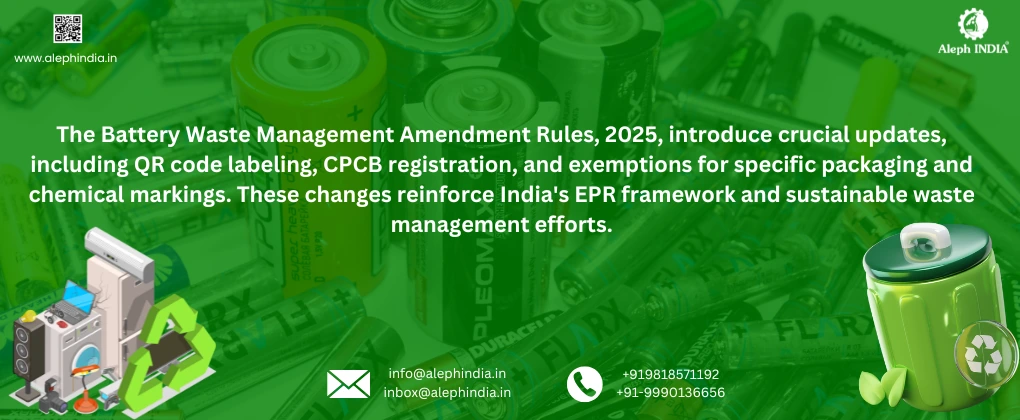
The Ministry of Environment, Forest, and Climate Change has issued the Battery Waste Management Amendment Rules, 2025 on 24th February 2025. These rules aim to further streamline the regulations governing the collection, recycling, and disposal of battery waste in India. This amendment serves as an update to the Battery Waste Management Rules, 2022, reinforcing the Extended Producer Responsibility (EPR) framework and enhancing environmental sustainability.
Key Highlights of the Amendment:
1. Exemption for Certain Packaging:
The amendment clarifies that packaging materials falling under Rule 26 of the Legal Metrology (Packaged Commodities) Rules, 2011 are exempt from certain packaging obligations under the Battery Waste Management Rules.
2. QR Code and Barcode Labeling:
Producers are now required to print barcodes or Quick Response (QR) codes displaying their EPR registration number on:
- Battery or battery pack
- Equipment containing battery or battery pack
- Packaging of battery or battery pack
- Packaging of equipment containing battery or battery pack
- Bulk packaging not meant for retail sale
- Additionally, the EPR registration number must be printed on the product information brochure.
3. Centralized Online Portal:
Producers must submit information to the Central Pollution Control Board (CPCB) through the centralized online portal, which will publish and update the list of registered producers quarterly.
4. Exemption for Cadmium and Lead Marking:
Batteries containing Cadmium concentrations ≤ 0.002% or Lead concentrations ≤ 0.004% by weight are exempt from mandatory chemical symbol markings (Cd or Pb).
Implications for Producers and Stakeholders
The amendments reinforce the government's commitment to sustainable waste management and circular economy principles. Producers must ensure compliance with the new labeling requirements and timely updates on the CPCB portal.
How This Affects the Industry
- Greater transparency in producer accountability
- Streamlined regulatory process through digital platforms
- Enhanced consumer awareness through product labeling