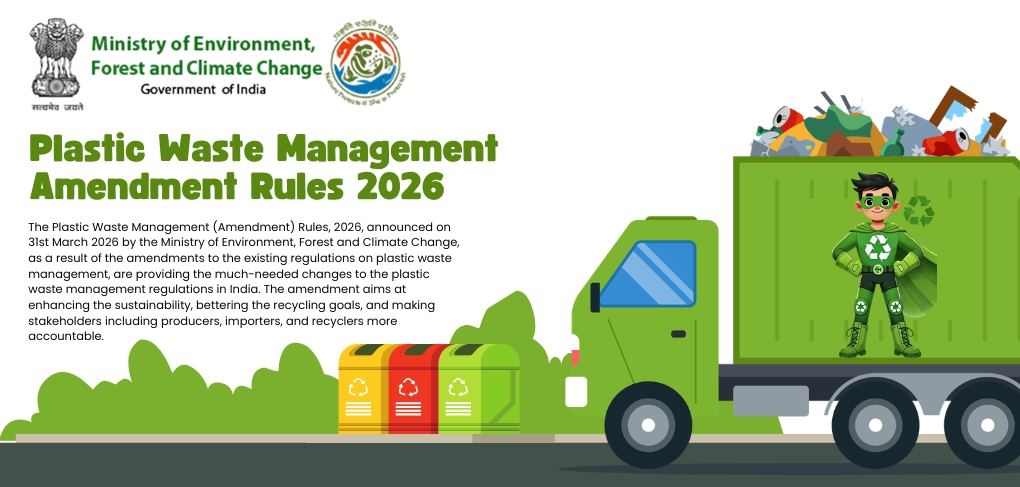
The Ministry of Environment, Forest and Climate Change (MoEFCC) has officially notified the Plastic Waste Management (Amendment) Rules, 2026 on 31st March 2026. These amendments further strengthen India’s regulatory framework for plastic waste management, emphasizing sustainability, recycling targets, and stricter compliance mechanisms.
This update builds upon the existing Plastic Waste Management Rules, 2016, introducing significant changes that impact producers, importers, brand owners, recyclers, and local authorities.
Key Highlights of the 2026 Amendment1. Revised Definition of End-of-Life Disposal
The amendment clearly defines end-of-life disposal to include:
- Waste-to-energy processes
- Co-processing in industries like cement and steel
- Waste-to-oil conversion
- Use in road construction
Importantly, conversion into new plastic products is excluded from this category and is considered recycling instead.
2. Introduction of New Definitions
Several new definitions have been introduced to bring clarity:
- Plastic Waste Processor: Includes both recyclers and entities involved in end-of-life disposal
- Reuse: Using products without altering their structure
- Seller: Entities dealing in plastic raw materials like resins or pellets
- Registered Environment Auditor: As per Environment Audit Rules, 2025
3. Mandatory Compliance with Indian Standard (IS 14534:2023)
All recycled plastic packaging must:
- Conform to IS 14534:2023
- Carry proper labeling indicating recycled content
- Meet additional requirements for food-contact applications as per FSSAI guidelines
4. Stronger Role of Local Authorities
The amendment empowers:
- Urban Local Bodies
- Gram Panchayats
- District Panchayats
to enforce rules related to:
- Plastic waste management
- Ban/restrictions on plastic carry bags and packaging
- Compliance with prohibited plastic items
This ensures grassroots-level enforcement across urban and rural areas.
5. State-Level Monitoring Committees
State Governments and UT Administrations must now establish State-Level Monitoring Committees comprising:
- Chief Secretary (Chairperson)
- Senior officials from urban, rural, and environment departments
- Pollution Control Board representatives
- Industry and NGO experts
This enhances accountability and monitoring efficiency.
These targets apply to:
- Producers
- Importers
- Brand Owners
Exceptions apply where recycled plastic is not permitted under specific laws (e.g., food safety or pharmaceutical regulations).
Carry Forward Mechanism
Entities are allowed to:
- Carry forward unfulfilled targets (for 2025–26)
- Meet them over the next 3 years
- Fulfill at least one-third of the backlog annually
Reuse Obligations for Rigid Plastic Packaging
Brand owners must ensure minimum reuse targets for Category I rigid plastic packaging:
- 10% (2025–26) → 25% (2028–29 onwards) for standard packaging
- Up to 85% reuse for large water packaging
This is a major step toward promoting a circular economy.
Audit & Verification Requirements
- Use of recycled content must be audited and verified
- Guidelines will be issued by the Central Pollution Control Board within 6 months
- Entities may engage Registered Environment Auditors
Reporting & Compliance
- Submit annual returns on the centralized portal
- Report:
- Total plastic usage
- Virgin vs recycled content
- Reuse performance
Failure to comply may attract penalties under the Environment Protection Act, 1986.
Key Impact on BusinessesFor Producers & Importers:
- Mandatory recycled content targets
- Additional compliance and reporting burden
For Brand Owners:
- Reuse obligations
- Responsibility for packaging quality and compliance
For Recyclers:
- Increased demand for recycled plastic
- Opportunities for growth
For Regulators:
- Stronger enforcement powers
- Structured monitoring systems
Conclusion
The Plastic Waste Management (Amendment) Rules, 2026 mark a significant step toward sustainable plastic usage in India. By enforcing higher recycling targets, promoting reuse, and strengthening monitoring systems, the government aims to reduce plastic pollution and encourage a circular economy.
Businesses must act proactively to:
- Align with new compliance requirements
- Invest in recycling and sustainable packaging
- Strengthen reporting and audit systems
Early adaptation will not only ensure compliance but also provide a competitive advantage in an increasingly eco-conscious market.